Your vault, your repo
A vault is a GitHub repo. Obsidian on your desktop and phone keeps working on the same files — no second sync system.
 karpathy.app
GitHub

karpathy.app puts your Markdown vault and an AI that reads, writes and ingests into it on your iPad, phone and Mac — synced through the GitHub repo you already have.
A vault is a GitHub repo. Obsidian on your desktop and phone keeps working on the same files — no second sync system.
Chat with any model — Claude, OpenAI, a local one. It searches, reads and edits your Markdown, and you see every file it touches.
Skills, AGENTS.md and CLAUDE.md in your vault work as they do in the terminal,
now from the sofa.
Your edits and the AI's stay uncommitted until you review them and commit. The AI never pushes on its own.
The demo vault on a Mac, an iPad and an iPhone: a wiki page next to a chat whose answer comes from the page the AI just read.
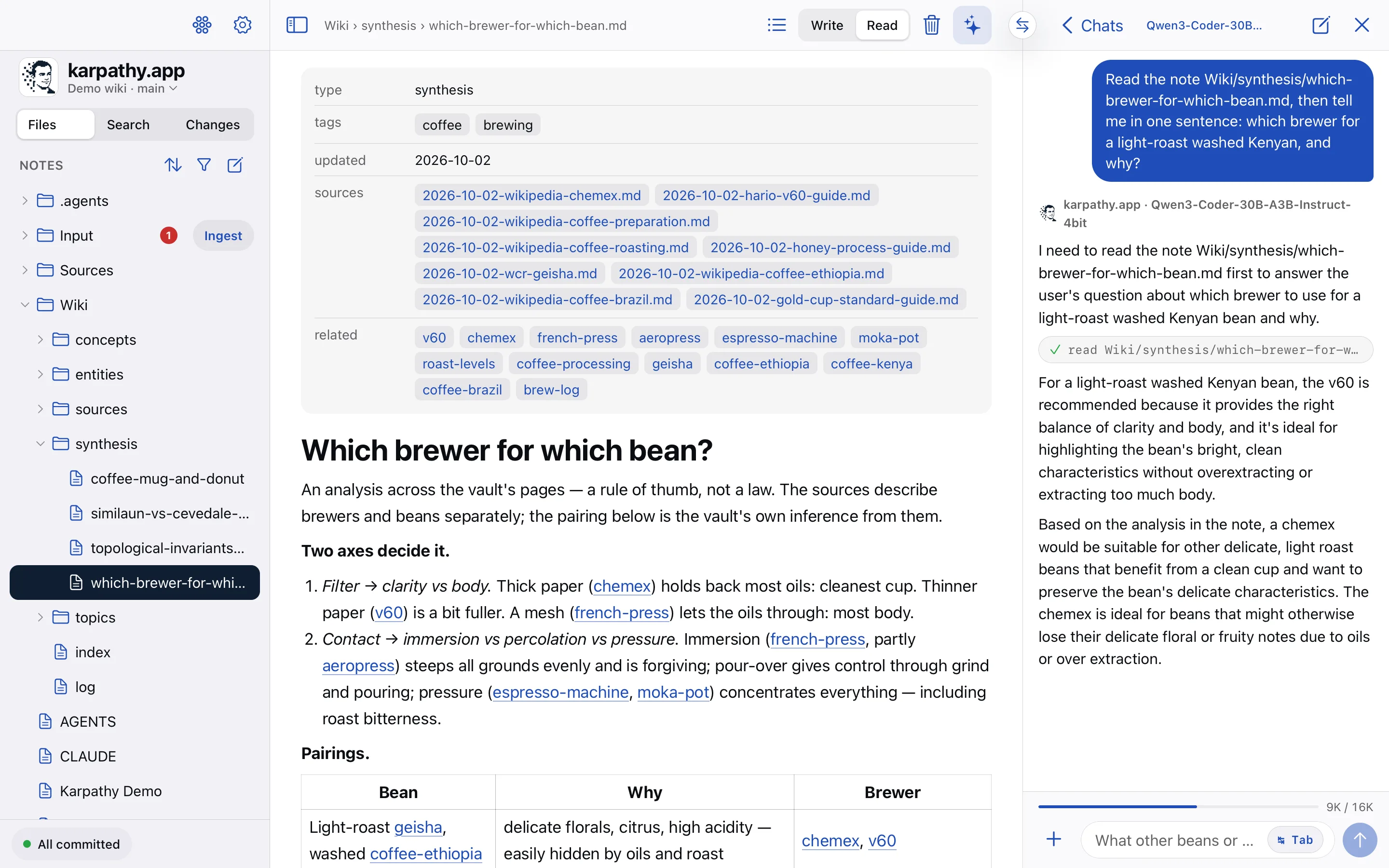
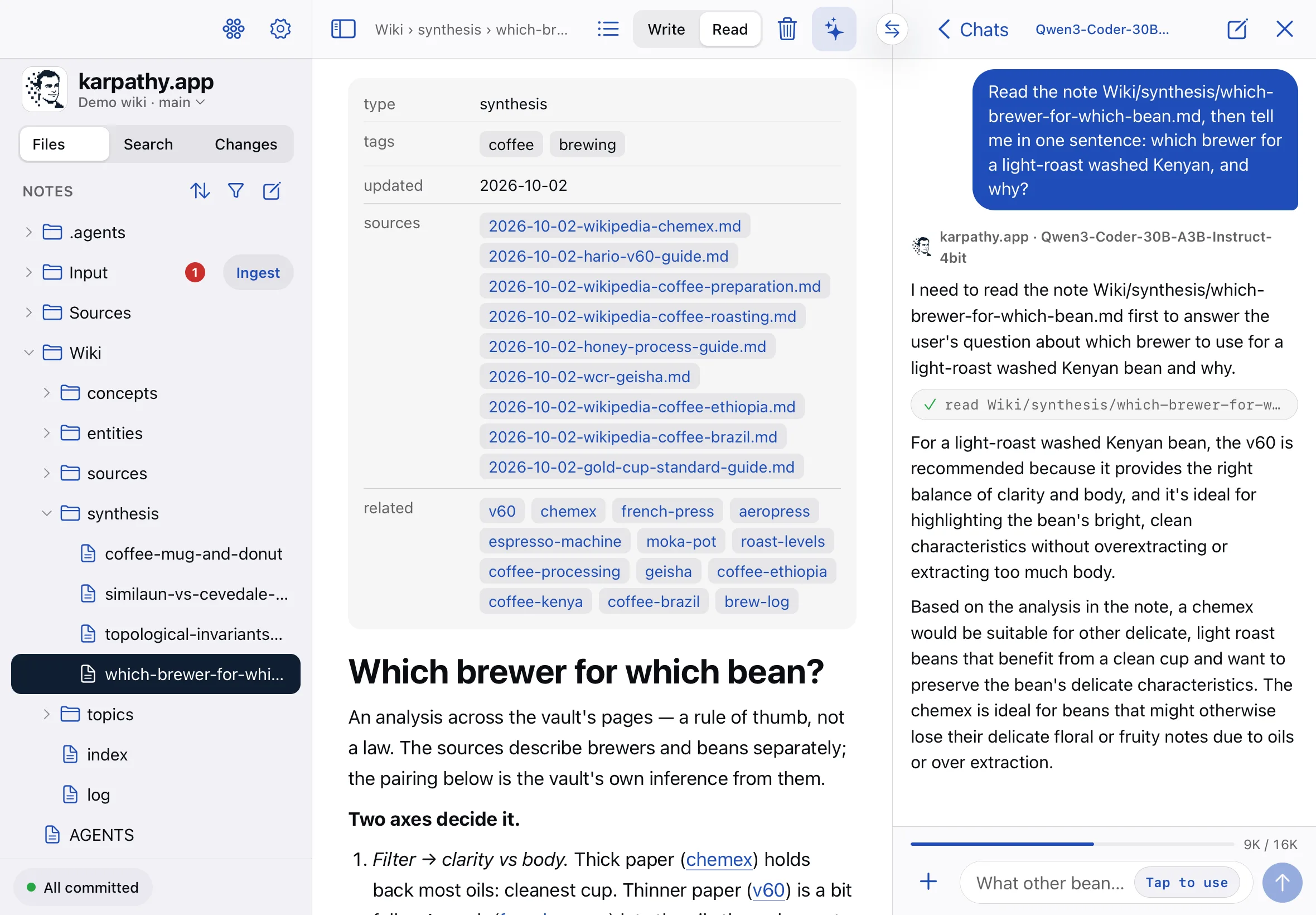
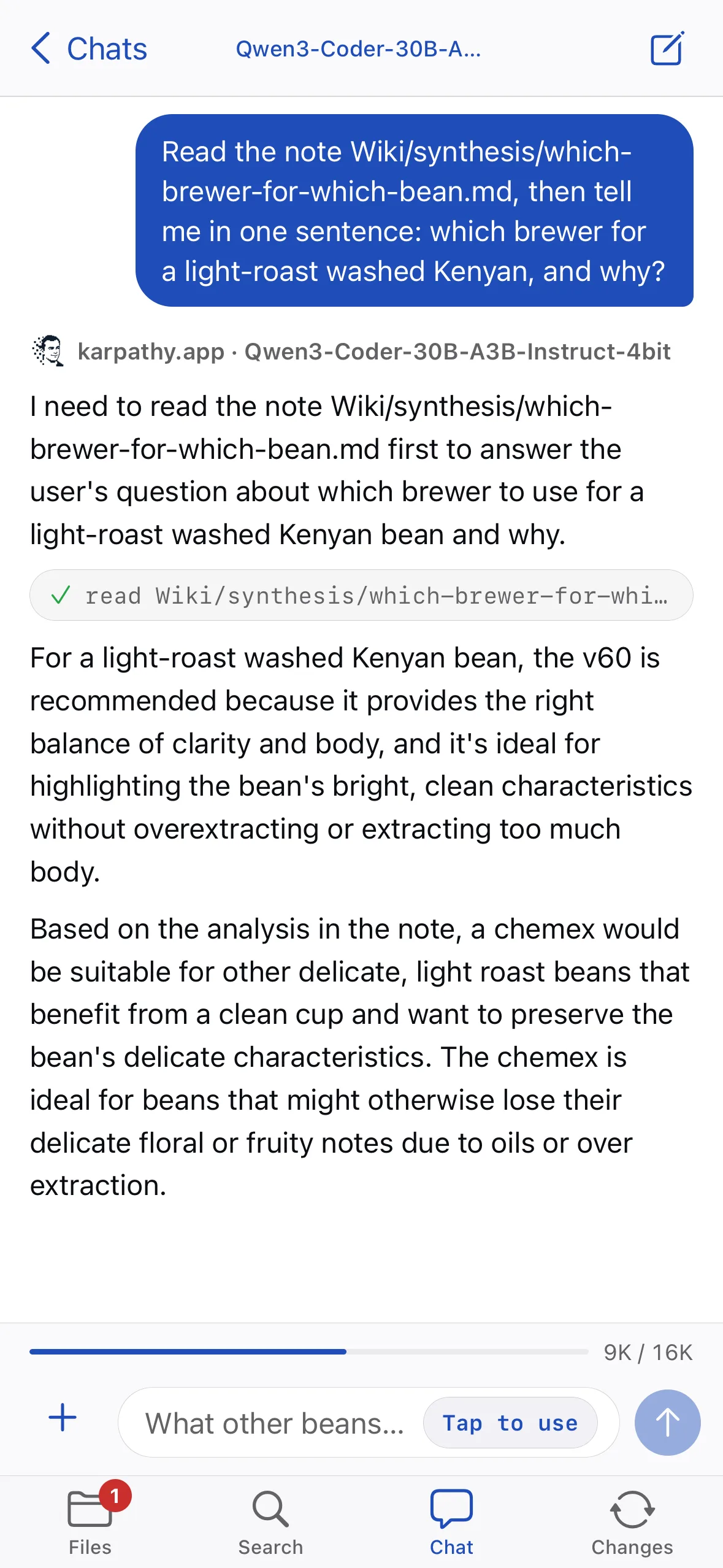
karpathy.app is built on an idea Andrej Karpathy shared in April 2026: let an LLM turn your raw sources into an interlinked Markdown wiki, and keep it healthy.
LLM Knowledge Bases
“Something I'm finding very useful recently: using LLMs to build personal knowledge bases for various topics of research interest. …”
Two days later, on , he wrote the pattern up as an “idea file”: raw sources go into a folder, the LLM ingests them into wiki pages, answers questions from the wiki and lints it.
That loop runs in a terminal. karpathy.app brings it — and your wiki skills — to the iPad and the phone.
karpathy.app is open source. We ship the code — not a running system. To use it, you run it yourself. That takes:
A small Linux box (e.g. 2 vCPU, 4 GB RAM) that runs the docker compose stack and holds the clones of your vaults.
The app isn't on the open internet: your iPad, phone and Mac reach it over your own tailnet.
A GitHub token for your vaults, an API key for your LLM provider, the app's access token, a DNS API key for the TLS certificate — and a safe place to keep them.
If you'd like karpathy.app as a hosted service, write me at till.gartner@gmail.com.